Multi-Tenant SaaS for Cooperative Ecosystems
Led seven developers as Lead Developer, System Analyst, and Solution Architect to build kuperasi.com from the ground up as a Laravel-based multi-tenant SaaS with a Kotlin member app, covering savings and loans, accounting, marketplace, PPOB, and configurable cooperative operations.
Project overview
kuperasi.com was built not as a one-off application for a single cooperative, but as a reusable SaaS product for multiple cooperative organizations with different operational rules.
I handled systems analysis, solution architecture, database design, technical leadership, and delivery with a seven-developer team. The main challenge was that each cooperative could have different savings-and-loan rules, tenors, margins/interest, approval policies, products, branding, and operating processes.
The core solution was tenant isolation plus configurable business rules so one product could serve multiple cooperatives without rebuilding the system for every organization.
Multi-tenant & configurable
Each cooperative had separated data, users, configuration, branding, products, financial rules, and approval workflows. The architecture and database were designed from the start so tenants could operate independently on the same product foundation.
Web admin + mobile member
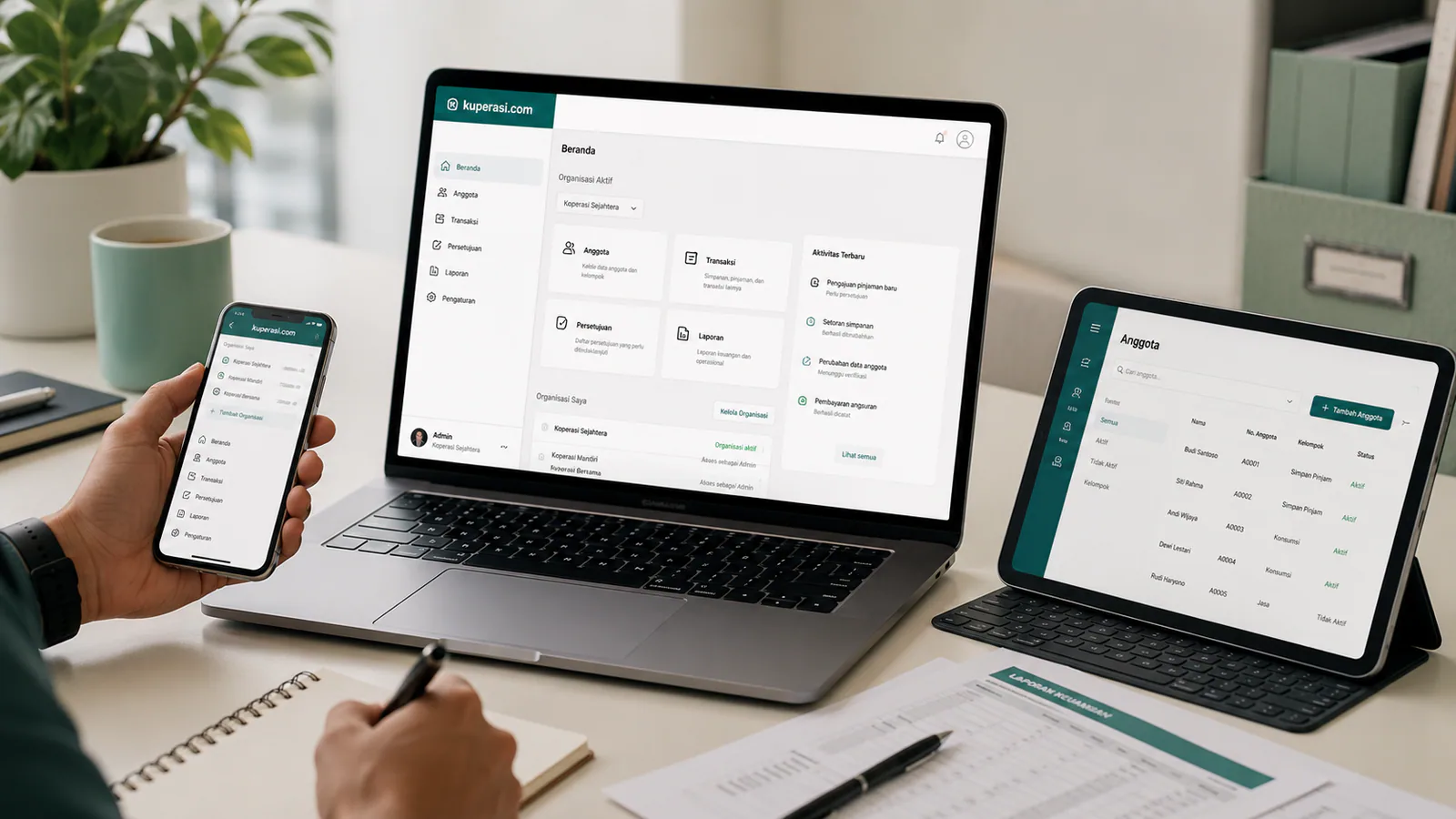
Cooperative administrators used the Laravel web platform for operations and administration, while members accessed services through a Kotlin application. Both shared the same underlying workflows and data ecosystem.
Financial & member ecosystem
The product covered members, savings, loans, installments, SHU, cash/bank, accounting, marketplace, PPOB, events, content, notifications, reporting, roles/permissions, and approvals.
Reusable product
The platform was deployed, went live, and was used in practice. Its main value was making cooperative digitalization repeatable across organizations with different configurations without starting development from scratch.
Modules & scope
- Member Management
Member records, accounts, status, profiles, and service access.
- Savings, Loans & Installments
Savings products, loan applications, approvals, disbursement, tenors, margins/interest, installments, and transaction tracking.
- SHU, Cash/Bank & Accounting
Cooperative finance operations, cash/bank management, accounting records, and SHU-related processing.
- Marketplace / Store
Commerce for members and cooperatives within the same digital ecosystem.
- PPOB
Digital payment services through external provider integrations.
- Events, News & Content
Cooperative information, events, agendas, and member-facing content.
- Notifications
Notifications for services, transactions, approvals, and member information.
- Roles, Permissions & Approvals
Access separation and approval workflows aligned with each cooperative's organization and policies.
- Multi-Tenant Configuration
Logos, branding, products, savings-and-loan rules, tenors, margins/interest, approvals, and operational configuration could differ per cooperative.
- Reporting
Operational, transaction, and activity reporting based on each tenant's data.
Outcomes & benefits
- One product for multiple cooperatives
The multi-tenant architecture allowed different cooperatives to share one product foundation while keeping data and configuration separated.
- Different rules could be configured
Products, tenors, margins/interest, approvals, branding, and operating rules could be tailored per cooperative.
- Connected member ecosystem
The web administration platform and Kotlin member application connected cooperative operations and member services in one ecosystem.
- Reusable product foundation
New cooperative implementations did not need to start from zero because the SaaS foundation, modules, and configuration could be reused.
- Used in practice
The product reached deployment, go-live, and real operational use.